September 8, 2026
We Took the Kia EV9 Camping in the Catskills and It Powered the Whole Campsite
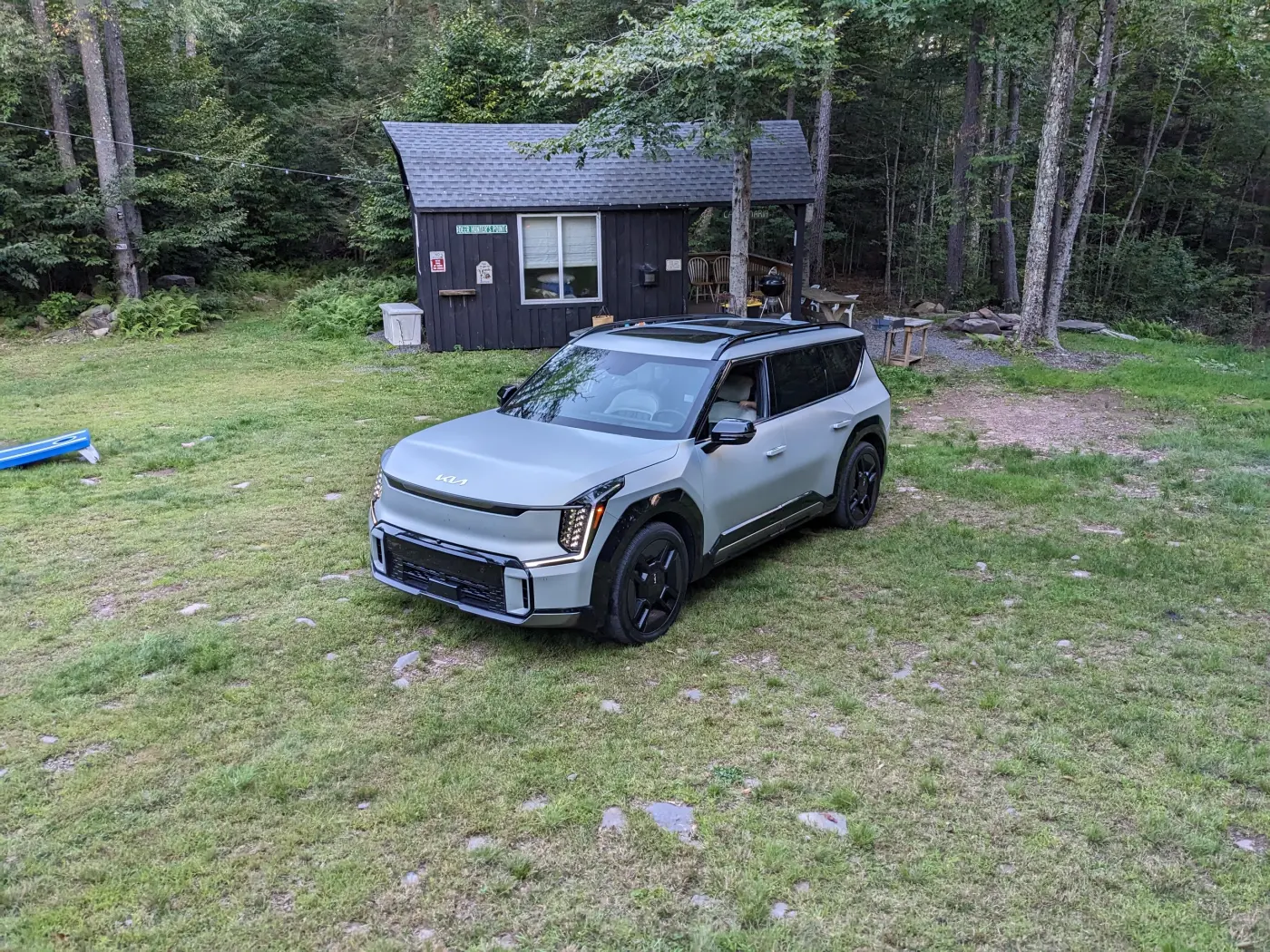
There is a particular kind of person who hears "we're taking the electric one" before a camping trip and makes a face. You know the face. It is the face of somebody already composing, in their head, the text message they will send from the shoulder of a mountain road. We have seen that face a lot this year. So when the newest vehicle in our fleet — a 2024 Kia EV9 GT-Line e-AWD, three rows, six seats, the size of a small apartment — needed a proper shakedown, we did not take it to a mall parking lot and time the acceleration. We loaded four people and an unreasonable quantity of gear into it and drove it into the Catskills for a weekend at a site with a fire pit, a cabin, tents, no running water, and effectively no electricity.
We came back with a few opinions. One of them we genuinely did not expect, and it is the reason this article exists rather than being a paragraph on the fleet page.
What's in this article
- Four adults, a weekend of gear, and one folded row
- The drive up, in the rain
- The whole weekend cost fifteen dollars to charge
- The part nobody expects: the car ran the campsite
- Gravel, a one-lane bridge, and 7.8 inches
- No bars, and why that mattered less than we thought
- What it is actually like inside for six hours
- Could you sleep in it? Honestly, yes
- The EV camping checklist we wish we'd had
- The numbers, from Kia and the EPA
- How it compares to the rest of our fleet
- Who should actually rent this thing
- Book it
Four Adults, a Weekend of Gear, and One Folded Row
Let us start with the boring problem that quietly ruins more trips than weather does: the packing. Four adults going camping for a weekend do not travel light, because camping is the one activity where the whole point is bringing your infrastructure with you. Tents. Sleeping bags. A cooler that weighs more than a person. Firewood, because the wood you buy at the site is always damp and always overpriced. Chairs. A grill. Water, in quantity, because there was none at the site. The bag of things nobody will use that comes anyway.
The EV9 is a six-seater in GT-Line trim, and we folded the third row flat. That is the configuration that makes this vehicle work, and the numbers behind it are genuinely unusual for something that still parks in a normal spot. Kia's own figures for the EV9 are 20.2 cubic feet behind the third row, 43.5 cubic feet behind the second, and a maximum of 81.7 cubic feet with the seats folded. Four people in the front two rows, third row down, and the entire back of the vehicle becomes a flat, square, deep load bay.
The word doing the work there is square. Cargo volume is a number that lies constantly, because a manufacturer can quote a big figure that is made up of awkward slivers around wheel arches and a sloping tailgate. The EV9's cargo area is close to a rectangle, the floor is flat when the third row is down, and the roofline does not taper the way a style-led crossover's does. In practice that meant we stopped playing the game where you take everything out and repack it a second time in a better order. Everything went in on the first attempt, with room left over, and nobody rode with a cooler between their feet.
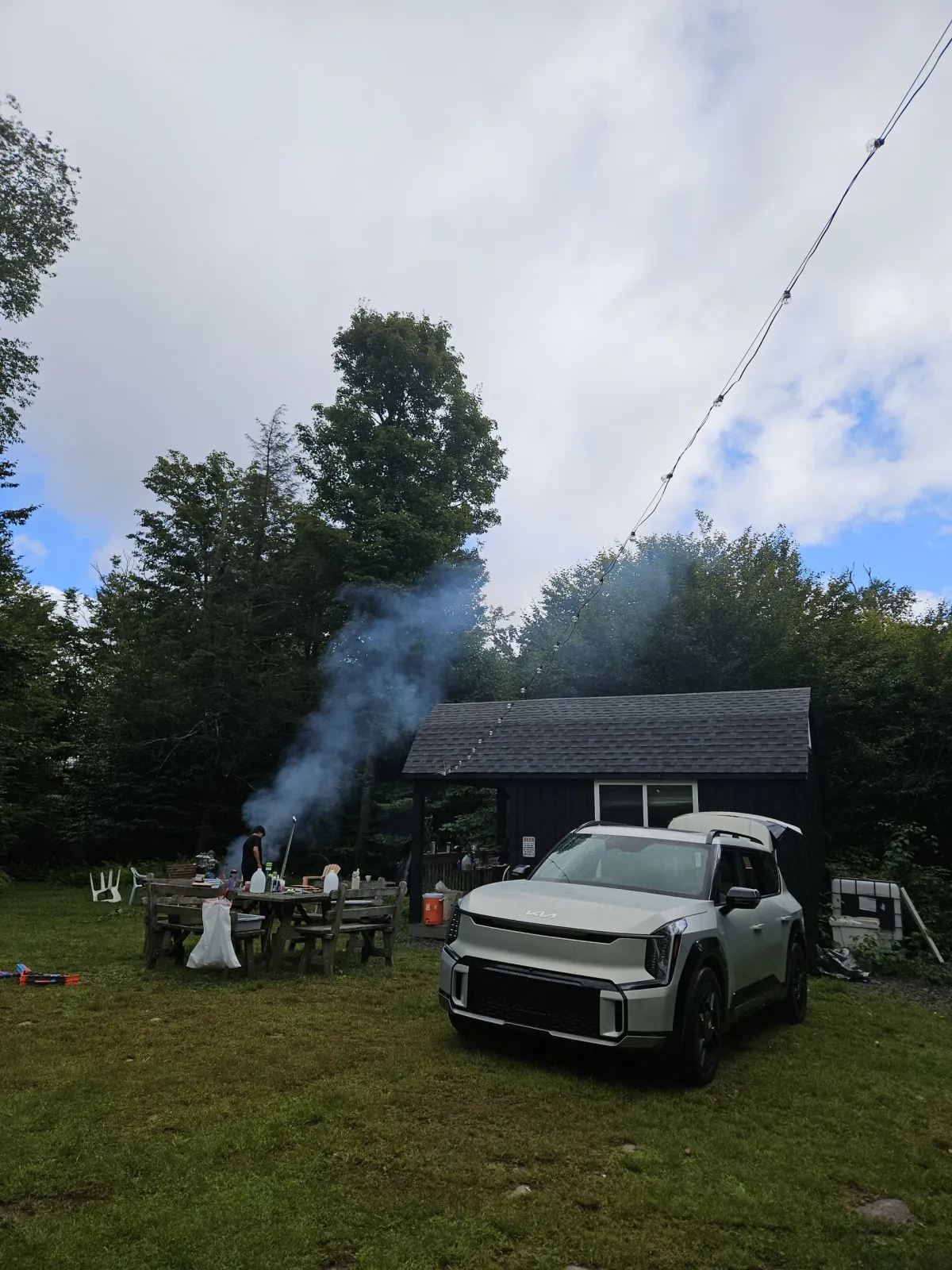
There is a second-order benefit to this that only shows up on a camping trip specifically. When you are not fighting for space, you bring the things that make a weekend outdoors pleasant instead of merely survivable. The good chairs instead of the folding ones that dig into your back. Two coolers, one for food and one for drinks, so nobody is excavating through ice to find the eggs. Proper pillows. The heavy cast-iron pan. All of it is optional, all of it is the difference between camping and enjoying camping, and all of it is the first thing cut when the vehicle is the constraint.
The Drive Up, in the Rain
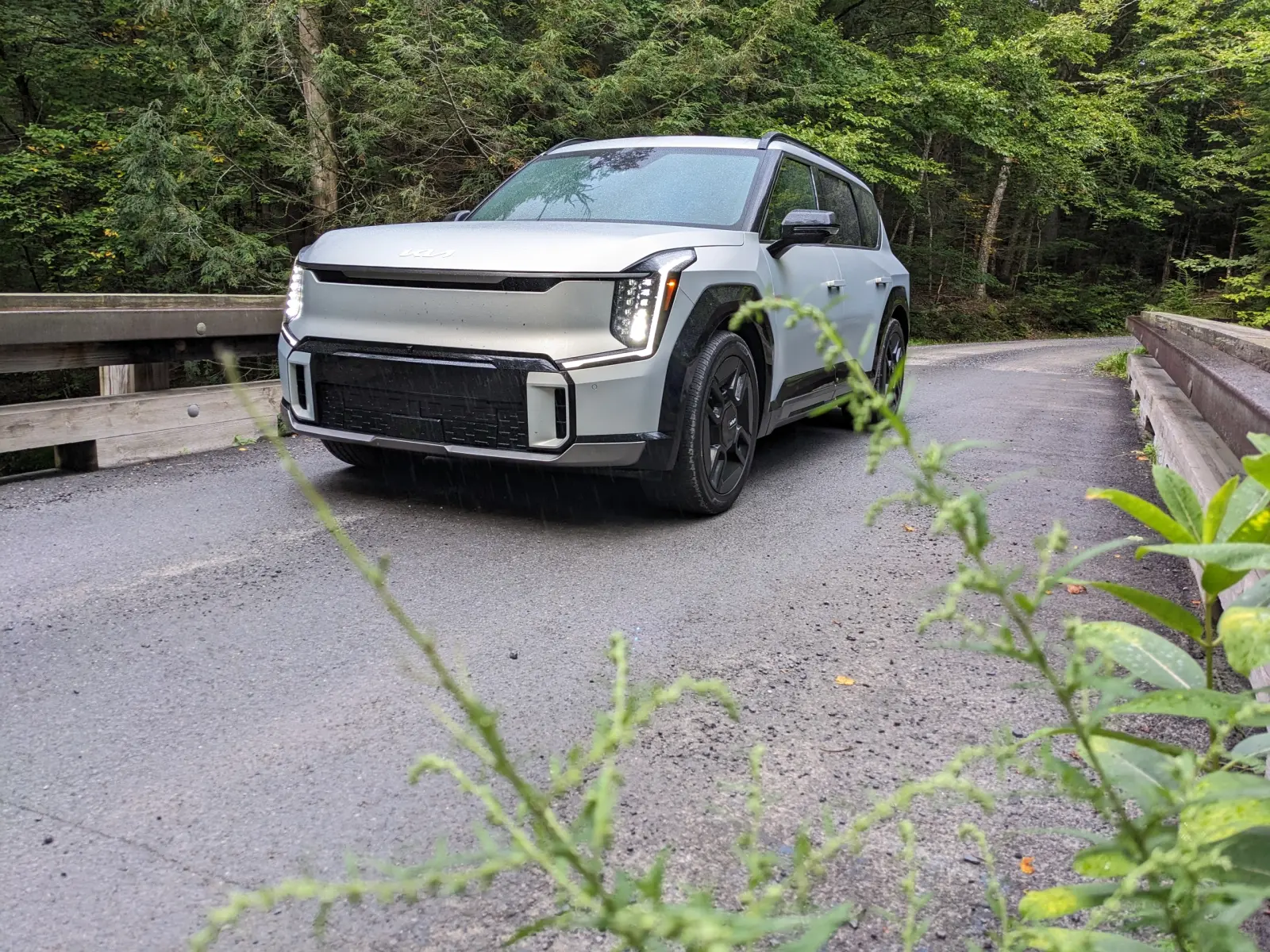
The run took about two and a half hours each way, and it rained for a good part of it. Not a dramatic storm — the steady, grey, all-afternoon Northeast rain that turns the last few miles of any mountain road into a slick, leaf-covered test of whether you actually trust a vehicle you have not driven much.
Two things stood out. The first is that the EV9 is quiet in a way that changes the character of a long drive with four people in it. Conversation happens at a normal volume. Nobody is leaning forward between the front seats and repeating themselves. Two and a half hours in a loud vehicle in bad weather leaves everyone frayed by the time they arrive; two and a half hours in this one did not.
The second is the driver assistance, which on the GT-Line includes Highway Driving Assist 2. On a long, wet highway slog with traffic that keeps compressing and releasing, adaptive systems stop being a novelty feature and start being the reason the driver arrives able to help set up a tent. That is not a small thing when the drive ends with physical work rather than a hotel check-in.
The Whole Weekend Cost Fifteen Dollars to Charge
Here is the number we keep repeating to people, because it is the one that reframes the entire argument. Charging for the whole trip — up, around, and back — cost about fifteen dollars. We returned to base with plenty of range still in the battery.
Fifteen dollars. For a five-thousand-plus-pound three-row SUV, fully loaded with four people and a weekend of gear, on a round trip of roughly five hours of driving through mountains. Run the same weekend in a comparable three-row gasoline SUV and you are looking at a tank and change. We are not going to pretend that difference funds a retirement, but it is the kind of number that makes people go quiet for a second, and it stacks up fast if you take four or five trips like this a year.
The reason it works is efficiency and charging speed, and both are documented rather than felt. The EPA rates the 2024 EV9 Long Range AWD GT-Line at 80 MPGe combined — 88 city, 72 highway — using 42 kWh per 100 miles, with an estimated annual fuel cost of $950 against the 15,000 miles a year the EPA assumes. The rated range is 270 miles on a full charge.
The charging side is where the EV9 separates itself from a lot of the field. It runs an 800-volt architecture, and Kia's figure is 10 to 80 percent in 24 minutes on a commercial 350 kW DC fast charger, or roughly 100 miles of range added in about 10 minutes for a quick stop. There is also a multi-charging system that handles anything from 400V to 800V, which matters in the real world because you do not always get to choose which charger is working when you pull in.
What that means practically is that an EV road trip stops being a planning exercise. Twenty-four minutes is a bathroom stop and a coffee. It is not an event you have to schedule the day around. That is the actual difference between a fast-charging EV and a slow one, and it is far more important than the headline range figure that everybody argues about online.
The Part Nobody Expects: The Car Ran the Campsite
Now the thing we did not see coming, and the reason we will be recommending this vehicle specifically for camping for as long as we have it.
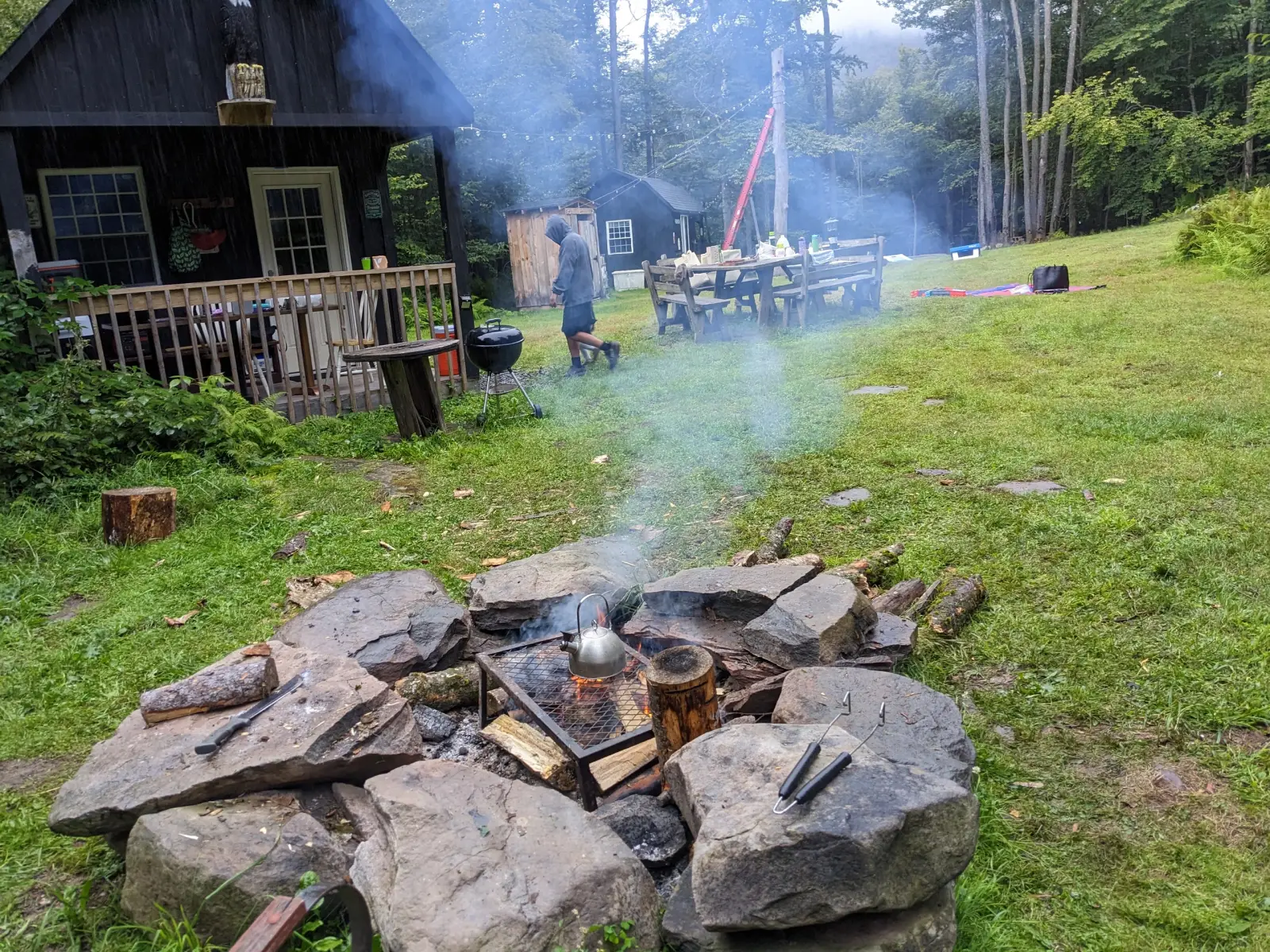
The site had a cabin, tents, a fire pit, and effectively no electricity and no running water. That is the honest, unglamorous version of a lot of beautiful places to camp in the Catskills. It is also the constraint that usually forces you into a set of compromises: battery lanterns that die, a cooler that becomes a bath of lukewarm water by Saturday afternoon, and coffee made in whatever way requires no power at all.
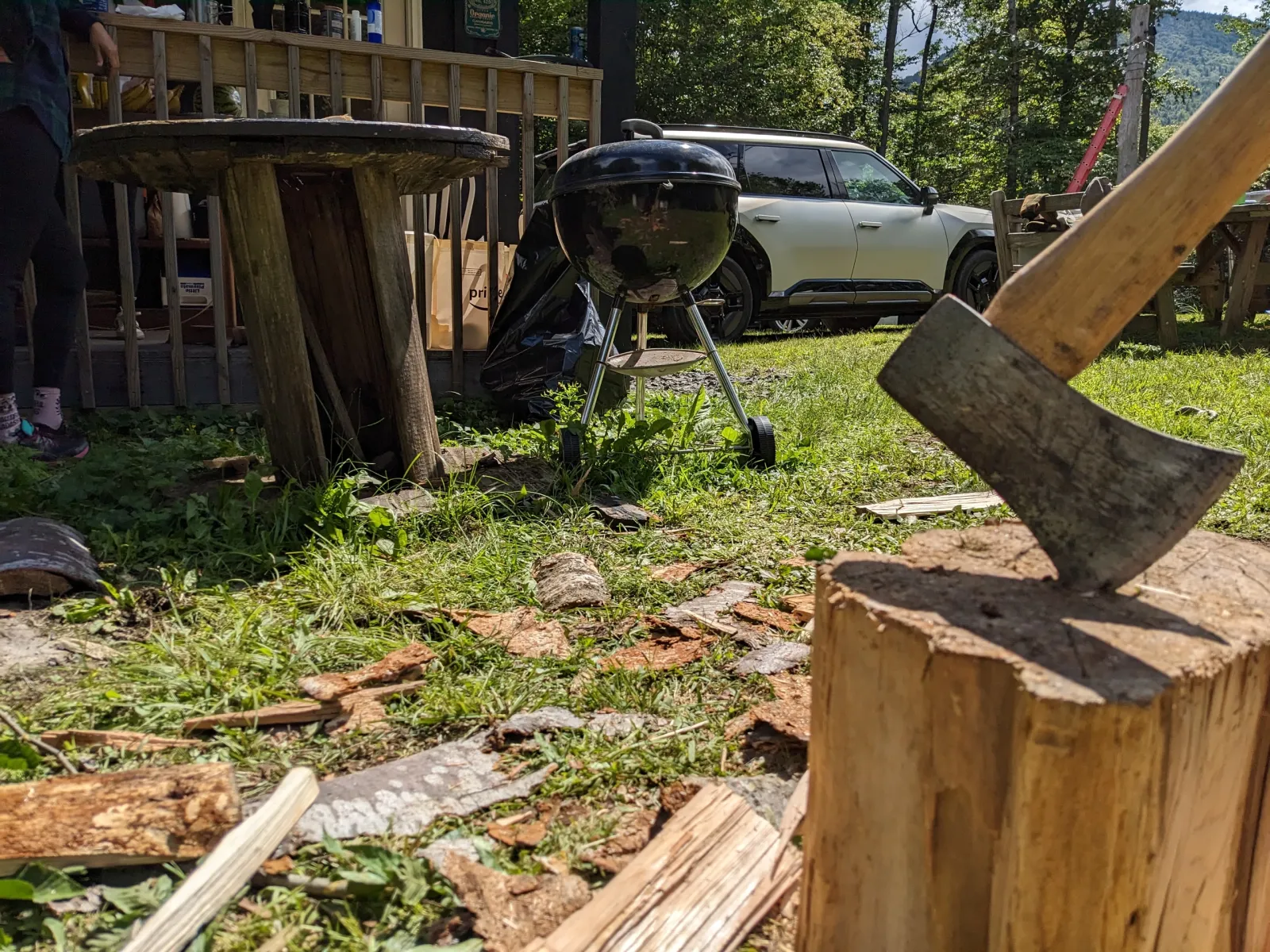
The EV9 has a feature Kia calls the Onboard Power Generator — vehicle-to-load, or V2L. In plain terms it turns the battery under the floor into a generator. Kia's specification is 1,920 watts of capability through a 110-volt outlet in the cargo area. We ran an extension cord out of the back of the vehicle and into the cabin, and for the weekend that outlet ran the lights, kept a fridge running, and powered a coffee grinder, along with the assorted small electrical nonsense that separates camping from glamping.
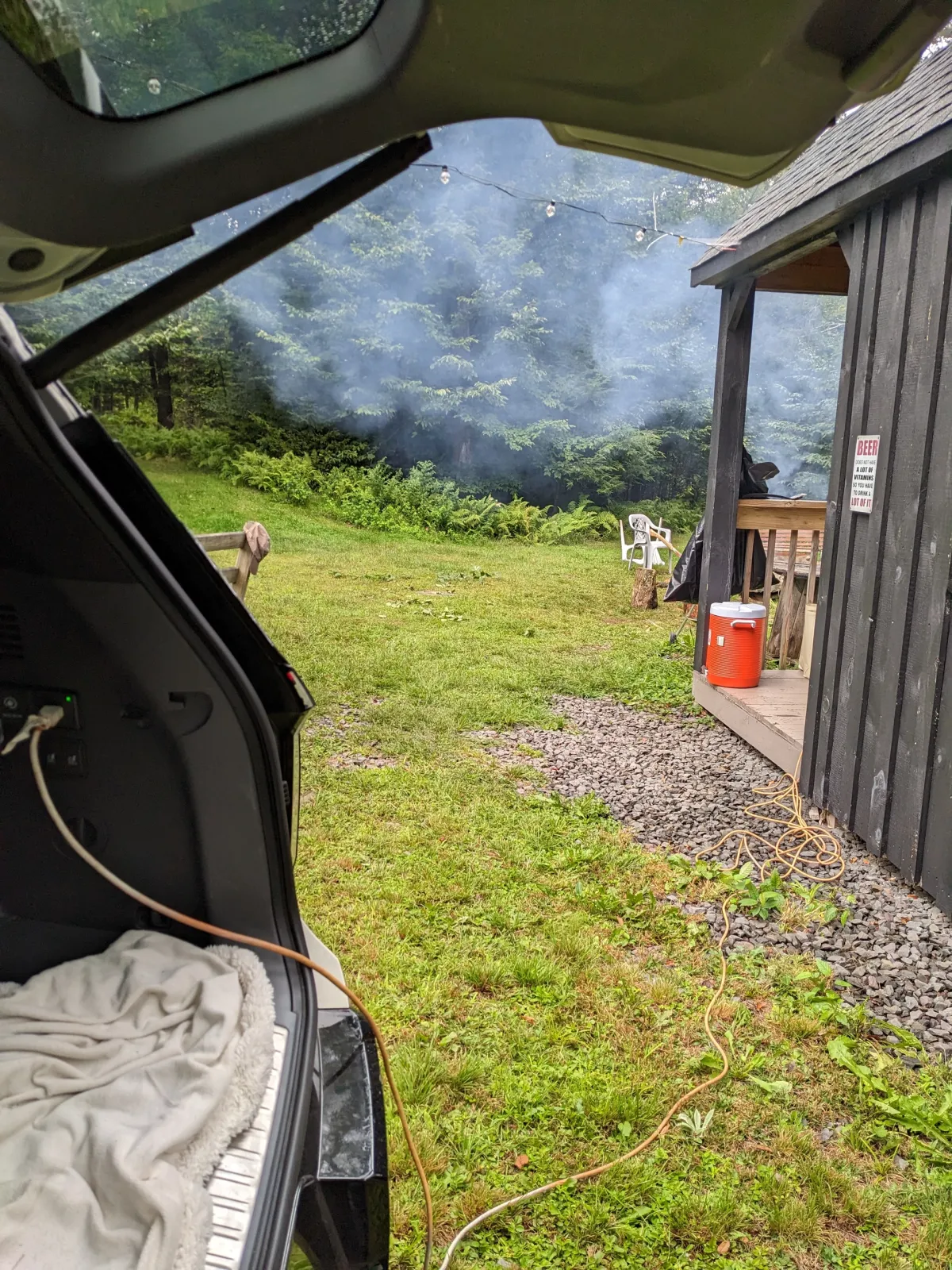
Kia's own brochure copy for the feature reads: "Power your laptop. Camping accessories. Even certain home appliances." That is a marketing line, and marketing lines usually evaporate on contact with an actual weekend. This one did not. Nineteen hundred watts is a real, useful amount of household power — not enough to run a space heater and a microwave simultaneously, but comfortably enough to keep a small fridge cold, a string of lights on, devices charged, and a kitchen appliance running. Worth flagging one detail from Kia's own fine print: the Onboard Power Generator requires separately sold equipment, so if you want the full exterior V2L setup rather than just the cargo outlet, that is a piece of kit to sort out rather than an assumption to make.
The strategic point is bigger than the convenience. A gasoline SUV parked at a campsite is dead weight for the entire time you are not driving it. This one was the single most useful object on the site for forty-eight hours, and the amount of range it cost us was not the sort of thing that troubled a battery of this size. The trip that made us understand the EV9 was not the drive. It was the two days it spent parked.
Gravel, a One-Lane Bridge, and 7.8 Inches
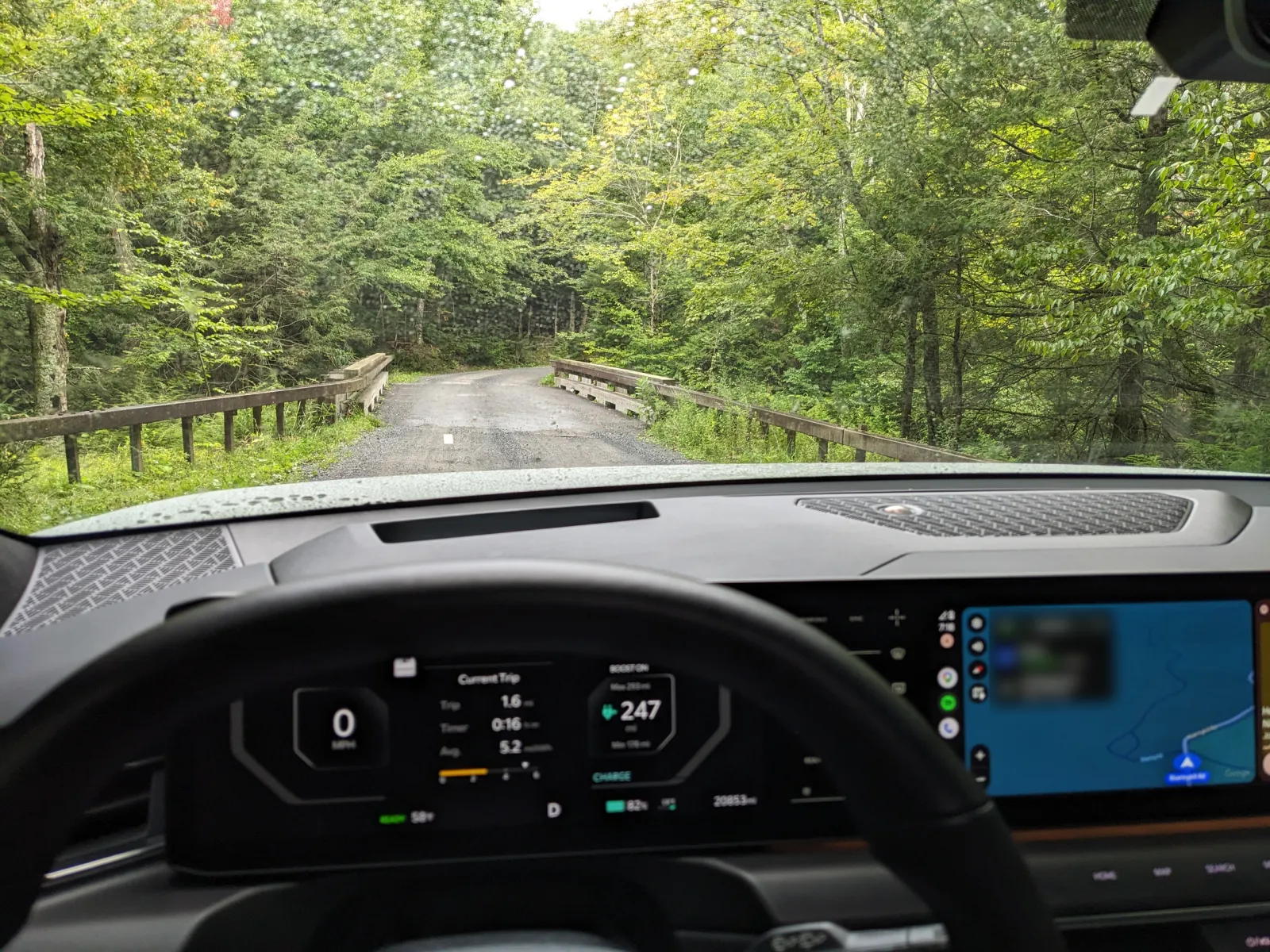
The access to a lot of the good sites in the Catskills is not paved, and it is not maintained to the standard of a road you would take a low-slung sedan down with confidence. Ours involved wet gravel, a forest track, and a one-lane timber bridge that looked exactly as old as it probably is.
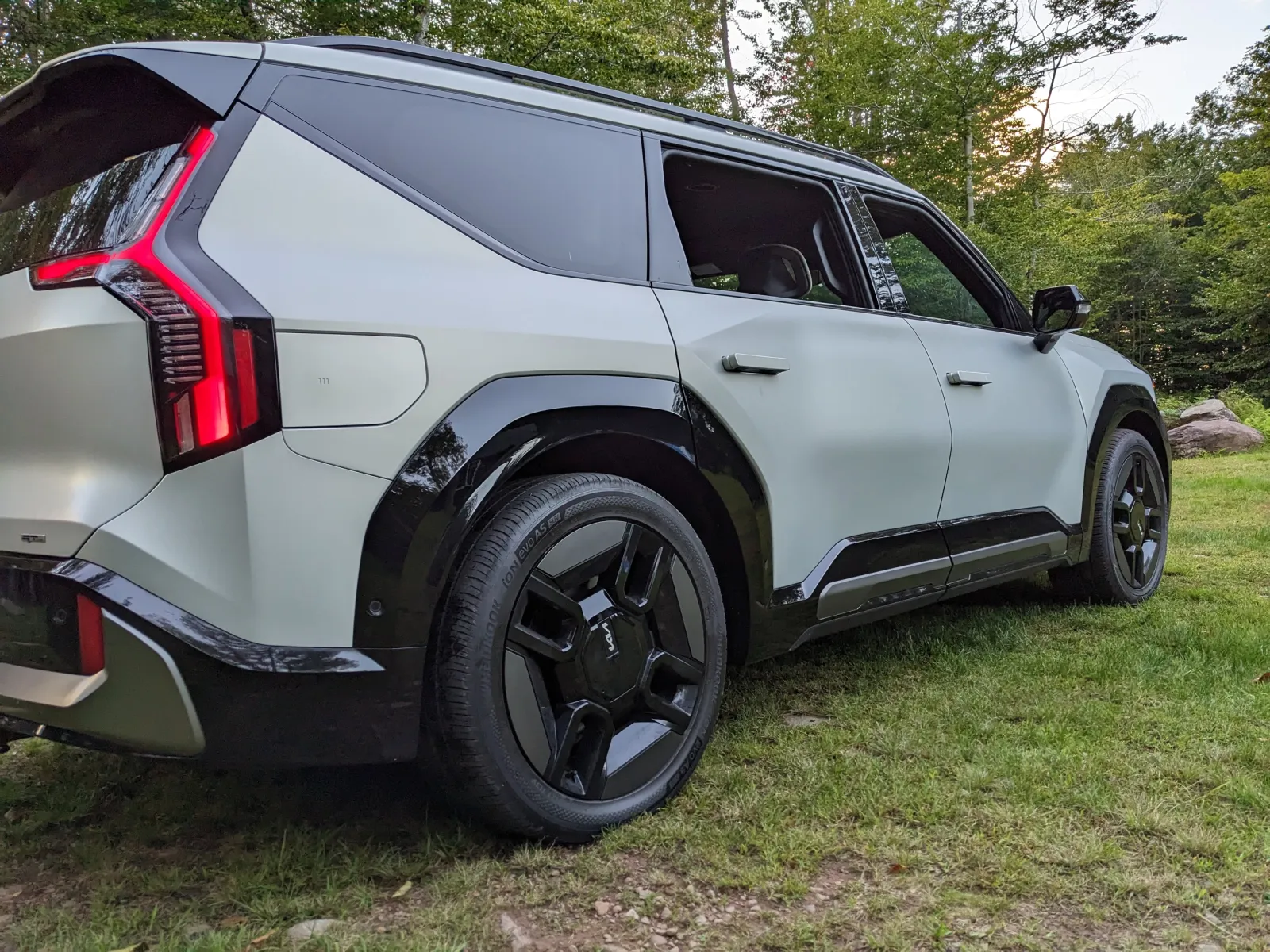
The EV9's AWD versions sit at 7.8 inches of ground clearance, run a torque-vectoring e-AWD system, and offer AWD Lock Mode and Snow Mode for conditions that need them. Combined output on the GT-Line e-AWD is 379 horsepower from a 283 kW dual-motor setup, with 443 to 516 lb-ft of torque depending on whether Boost is engaged. Kia quotes 0 to 60 in 4.5 seconds, from AMCI-certified testing on dry pavement in August 2023.
None of which is really the point on a wet forest track. What matters there is that an electric drivetrain meters torque with a precision a torque converter and a gearbox cannot match. On a loose, wet surface you get exactly the amount of push you asked for, immediately, at each wheel that can use it. Low-speed crawling over uneven ground — the thing you actually do on a camp road — is where EVs quietly outperform, and it is not something that shows up in any specification sheet.
Two honest caveats. This is a road-biased three-row SUV with all-wheel drive and useful clearance; it is not a trail vehicle, and 7.8 inches is enough for a rough access road and not for rock crawling. And it is a heavy vehicle — curb weights across the EV9 range run up to 5,800 pounds, with GT-Line at the top of that range. Heavy is fine on gravel and genuinely helpful in the wet, but it is worth knowing before you point it at soft ground you have not walked first.
No Bars, and Why That Mattered Less Than We Thought
There was no usable cell service at the site and patchy coverage for the last stretch of the drive in. This is normal for the Catskills and it is the single most common thing that goes wrong on a trip like this, because the modern default is that the phone handles everything — the route, the weather, the group chat coordinating three cars.
Navigation held up well on spotty coverage, which was the pleasant surprise of the drive. The practical lesson is one we would give to anybody renting any vehicle from us for a mountain weekend: set your destination and download your offline maps before you leave the last town with real service. Do it at the gas station or the last supermarket. Once the route is loaded, the drive stops depending on a signal you are about to lose.
The corollary is that you should tell somebody your plan before you go dark, and agree that no news is good news. Half the panic that comes out of a camping weekend is somebody at home watching a message go undelivered for six hours.
What It Is Actually Like Inside for Six Hours
Five hours of round-trip driving with four adults is a real test of an interior, and the EV9's cabin is its strongest argument after the V2L outlet.
GT-Line trim is configured as a six-seater, with captain's chairs in the second row rather than a bench. This is the correct configuration for adults and it is worth understanding why: captain's chairs create an aisle. That aisle means the person in the third row does not need anybody to move, climb out, or fold anything to get in or out. It converts the third row from a place you put someone as a punishment into a genuine seat. Kia quotes 160.3 cubic feet of passenger volume in the six-passenger configuration.
Up front there is a 29.6-inch combined panoramic display running across the dashboard, and on GT-Line a 14-speaker Meridian premium audio system. The Meridian setup is a genuine upgrade rather than a badge — on a long drive with a car full of people who each have opinions about music, a system that stays clean at volume is not a luxury.
For a trip that ends in the mountains, the cold-weather engineering deserves a mention, because it is the thing that separates an EV that works in a Northeast winter from one that disappoints. The EV9 uses an advanced battery heater, and a heat pump HVAC system is fitted on the Wind, Land and GT-Line trims. A heat pump moves heat rather than generating it with resistance, which means cabin heat costs the battery dramatically less. On a 40-degree morning in November that is the difference between the range you were promised and the range you get.
One more figure that matters for the family use case: the EV9 is rated to tow up to 5,000 pounds when properly equipped with a weight-distributing hitch. A three-row electric SUV that can also pull a small boat or a utility trailer is a genuinely short list.
Could You Sleep In It? Honestly, Yes
We did not sleep in the vehicle — we had tents and a cabin, which is the whole reason you go to a place like this. But the question came up around the fire on Saturday night, the way it always does, and having looked properly at the folded floor, the answer is yes.
With the third row down the load floor is flat and long, and unlike a gasoline vehicle you are not choosing between running the engine all night for climate control and freezing. An EV can hold a cabin temperature overnight off the traction battery without idling an engine, without exhaust, and without noise. That is a meaningfully different proposition, and it is the reason car camping in EVs has quietly become a real thing rather than a stunt.
We are flagging it as a possibility rather than a recommendation, because we have not tested it ourselves and we do not put things in these articles that we have not done. If you rent it and try it, tell us how it went. We will update this section with what you find.
The EV Camping Checklist We Wish We'd Had
We worked a few of these out the hard way, so you do not have to. None of it is complicated, but all of it is the sort of thing you only think about once you are already three hours from home.
Bring a proper outdoor extension cord, and bring more of it than you think. This is the single highest-value item on the list and it costs about twenty dollars. The outlet is in the cargo area, which means the vehicle has to be parked within cord's reach of wherever you want power. Campsites do not let you choose exactly where the flat, dry parking spot sits relative to the cabin. Fifty feet of outdoor-rated cord turns "we can power the site" from a maybe into a certainty. An indoor cord in wet grass is not the place to economize.
Work out your power budget before you leave, roughly. Nineteen hundred watts is a lot, but it is not unlimited, and the number that matters is not the total — it is what is running simultaneously. A small fridge, a string of lights and a laptop charger together are trivial. A fridge plus a kettle plus a heater at the same moment is not. Anything that makes heat is the expensive one: kettles, toasters, hair dryers and space heaters all draw enormous power for what they do. Anything that makes light or cold or charges a battery is cheap. Stagger the heat-making things and you will never come close to the limit.
Charge to full before the last leg, not at the last town. The best charging stops are on the highway where the fast chargers are, not in the small mountain towns where they may be slow, occupied or broken. Fill up while you are still on the interstate and treat the last hour of mountain road as a range cost you have already paid.
Download offline maps and set the destination while you still have bars. We covered this above but it belongs on the checklist, because it is the mistake that actually strands people. Two minutes at the last supermarket.
Park nose-out on grass. Two days of rain turns a grass pitch into something a two-and-a-half-ton vehicle can churn. Backing in when the ground is firm on Friday is much easier than driving out of a rut on Sunday.
Take the cargo cover out and leave it at home. If you are folding the third row and filling the back, the parcel shelf is just one more thing to store somewhere. Decide before you pack, not in the driveway with everything already loaded.
The Numbers, From Kia and the EPA
| Battery | 99.8 kWh, 552-volt lithium-ion polymer |
|---|---|
| Motors | 283 kW dual-motor e-AWD |
| Power & torque | 379 hp; 443–516 lb-ft |
| 0–60 mph | 4.5 seconds (AMCI certified) |
| EPA range | 270 miles |
| EPA efficiency | 80 MPGe combined (88 city / 72 hwy); 42 kWh per 100 miles |
| DC fast charging | 800V system; 10–80% in 24 minutes on a 350 kW charger; about 100 miles in 10 minutes |
| Onboard Power Generator (V2L) | 1,920-watt capability, 110V cargo-area outlet |
| Cargo volume | 20.2 cu ft behind row 3 / 43.5 behind row 2 / 81.7 maximum |
| Towing | Up to 5,000 lbs with a weight-distributing hitch |
| Ground clearance | 7.8 inches (AWD) |
| Traction | Torque-vectoring e-AWD with AWD Lock Mode and Snow Mode |
| Audio & displays | 14-speaker Meridian premium audio; 29.6-inch combined panoramic display |
| Seating | Six, with second-row captain's chairs |
On safety, the 2024 EV9 earned a Top Safety Pick award from the Insurance Institute for Highway Safety. One piece of precision matters there: for the Land and GT-Line trims, it is vehicles built after January 2024 that meet the award's headlight criterion, after Kia adjusted the headlight aim to reduce glare. We would rather give you the caveat than the round number.
How It Compares to the Rest of Our Fleet
We run several vehicles that could all plausibly be described as "the big one," and people ask us to choose for them constantly. Here is how we actually think about it.
Against our 2022 Kia Telluride, the EV9 trades two seats for a power outlet and a fuel bill of roughly nothing. The Telluride seats eight to the EV9's six, carries slightly more maximum cargo at 87.0 cubic feet against 81.7, and refuels anywhere in four minutes. Both tow 5,000 pounds. The Telluride is the right answer for a big group, a long interstate haul, or anybody who does not want to think about charging at all. The EV9 is the right answer for almost everything else, and it is emphatically the right answer for camping.
Against our 2026 Tesla Model Y, it is a straightforward question of scale. The Model Y is more efficient, goes further between charges at an EPA-rated 327 miles, and is the better vehicle for two to four people doing a lot of highway miles. The EV9 is a substantially larger vehicle with a third row, far more cargo, a tow rating, and the V2L outlet. If your trip is defined by how much you are bringing and how many people are coming, take the EV9. If it is defined by distance, take the Model Y.
Against our 2023 Tesla Model 3, there is no real comparison to make — they solve different problems. The Model 3 is the efficient, quick, inexpensive-to-run sedan for a couple or a small family. The EV9 is the vehicle you rent when the Model 3 is not big enough, which is precisely why we run both.
Who Should Actually Rent This Thing
Families who need three rows for part of a trip and cargo for the rest. This is the core case. Six proper seats when you need them, 81.7 cubic feet when you do not, and no penalty for switching between the two mid-weekend.
Anybody going somewhere with unreliable power. Camping, a rental cabin with temperamental wiring, a beach house at the end of a road that loses power in every storm, a tailgate, an outdoor event, a job site. If your destination's electricity is a question mark, this vehicle answers it.
People curious about EVs who do not want to be a test pilot. Renting an EV for a weekend is the cheapest possible way to find out whether the ownership version would work for your actual life, rather than the version of your life you imagine when reading a spec sheet. Two days will tell you more than two months of research.
Anyone doing a long Northeast haul with a full car. The quietness and the driver assistance are what you are really buying for a five-hour drive, and they are the two things nobody thinks to ask about.
And the honest counter-case, because we would rather you rent the right vehicle than the wrong one twice. If your trip is a long interstate run into an area you know has thin charging infrastructure, and you have no interest in thinking about it at all, take the Telluride instead. It seats eight, tows the same 5,000 pounds, and refuels anywhere in four minutes. Different tool, same job, and we would rather point you at the right one.
Book It
The EV9 is the newest vehicle in the Frosty Flame LLC fleet, based in Bergen County and available for exactly the kind of weekend described above — or the far more ordinary one where you need six seats and a big trunk for a couple of days. Rent direct from us,'re protected, with 24/7 roadside assistance. And we deliver.
Book directly with us and we will confirm the dates and sort out delivery.
Reserve the Kia EV9
Take it camping, take it to the airport, or take it to find out whether you want one. Book direct with us.
Book Direct With UsFollow the Adventure on Instagram
New arrivals, road-trip shots, and behind-the-scenes detailing chaos all land on our feed first. Tag us in your trip photos and we'll share our favorites.
Follow @frostyflame_llcWant to See the Rest of the Fleet?
Teslas, three-row SUVs and more, all based in Bergen County with delivery across North Jersey.
View Our Fleet
Written by Frankie
Frankie is Chief Editor & Marketing Director for Frosty Flame Vehicle Rentals.
#nyc #newjersey #nj #VisitNJ #ExploreNJ #NJSpots #ILoveNY #UpstateNY #ExploreNY


Permalink: frostyflame.llc/blog/kia-ev9-catskills-camping.html